Angela Davis by Angela Y. Davis
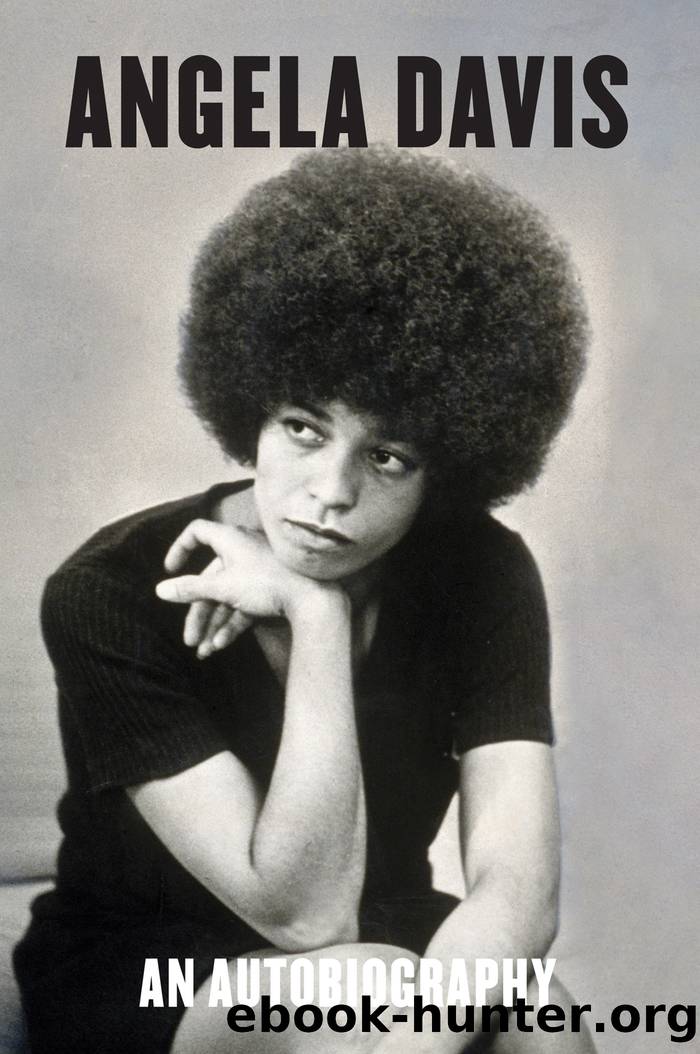
Author:Angela Y. Davis
Language: eng
Format: epub
Publisher: Haymarket Books
Published: 2021-02-15T00:00:00+00:00
The era of massive national conferences was still in full force. In July 1969, movement activists, Black, Brown, and white, from throughout the country, converged in Oakland, California, to attend a conference called by the Black Panther Party to found a United Front Against Fascism.
The organizational theory behind the conference was excellent: people with various ideologiesâthe broadest possible representation of peopleâjoined together to forge a United Front to combat the increasingly ferocious repression. But there were problems with the conference, and I was perhaps overly sensitive, since I had just recently been forced to break my relatively close ties with the Panthers. The basic difficulty, I thought, was that we were being asked to believe that the monster of fascism had already broken loose and that we were living in a country not essentially different from Nazi Germany. Certainly, we had to fight the mounting threat of fascism, but it was incorrect and misleading to inform people that we were already living under fascism. Moreover, the resistance dictated by such an analysis would surely lead us in the wrong direction. First, in seeking to include absolutely everyone who had an interest in overthrowing that fascism, we might be pushed into the arms of the liberals. Our revolutionary thrust would thus be blunted. And if we were not led in that direction, we would be pressed toward the opposite end of the political spectrum. For, if we believed we were living under genuine fascism, it would mean that virtually all democratic channels of struggle were closed and we should immediately and desperately rush into the armed struggle.
In many of the speeches, the word âfascismâ was used interchangeably with the word âracism.â Certainly, there was a definite relationship between racism and fascism. If a full-blown fascism ever erupted in the United States, it would certainly ride on the back of racism in much the same way that anti-Semitism provided the handle for German fascism in the thirties. But to think that racism was fascism and fascism was racism was to cloud the vision of those who were attracted to the struggle. It was to hamper their own political development and to impede the organized mass fight against racism, against political repressionâand especially in defense of the embattled Panthers.
In the midst of the confusion, Herbert Aptheker, the Communist historian, made an excellent presentation, laying out the relationship between racism today and the potential of fascism tomorrow. For me, it confirmed the correctness of my decision to join the Communist Party almost a year ago to that date.
With all its obvious flaws, the conference was nevertheless one of the most important political events of the season. It established the basis for breaking out of the narrow nationalism so prevalent in the Black Liberation Movement and pointed the way for alliances between people of color and white people around issues that involved us all.
As soon as the conference had adjourned, Kendra and I boarded a plane for Mexico City, where we joined the remaining members
Download
This site does not store any files on its server. We only index and link to content provided by other sites. Please contact the content providers to delete copyright contents if any and email us, we'll remove relevant links or contents immediately.
| Anthropology | Archaeology |
| Philosophy | Politics & Government |
| Social Sciences | Sociology |
| Women's Studies |
Cecilia; Or, Memoirs of an Heiress — Volume 1 by Fanny Burney(32574)
The Great Music City by Andrea Baker(32039)
Cecilia; Or, Memoirs of an Heiress — Volume 2 by Fanny Burney(31970)
Cecilia; Or, Memoirs of an Heiress — Volume 3 by Fanny Burney(31950)
We're Going to Need More Wine by Gabrielle Union(19063)
All the Missing Girls by Megan Miranda(16091)
Pimp by Iceberg Slim(14547)
For the Love of Europe by Rick Steves(14270)
Bombshells: Glamour Girls of a Lifetime by Sullivan Steve(14091)
Talking to Strangers by Malcolm Gladwell(13395)
Norse Mythology by Gaiman Neil(13390)
Fifty Shades Freed by E L James(13254)
Mindhunter: Inside the FBI's Elite Serial Crime Unit by John E. Douglas & Mark Olshaker(9361)
Crazy Rich Asians by Kevin Kwan(9304)
The Lost Art of Listening by Michael P. Nichols(7517)
Enlightenment Now: The Case for Reason, Science, Humanism, and Progress by Steven Pinker(7321)
The Four Agreements by Don Miguel Ruiz(6775)
Bad Blood by John Carreyrou(6629)
Weapons of Math Destruction by Cathy O'Neil(6295)
